No one likes the feeling of turning the key and hearing nothing. Or pressing the start button and getting a silent dashboard. A car that won’t start can ruin your morning, delay your plans, and cause instant stress. But the good news is simple. Many starting problems can be fixed on the spot with quick checks. In most cases, you may not even need a tow truck.
This guide will teach you easy steps to follow when your car refuses to start. These steps are safe, simple, and perfect for any driver. With a calm approach and a little patience, you may get your car running again in minutes.
- Stay Calm and Think for a Moment
- Check if the Car Is Actually in Park or Neutral
- Look at Your Dashboard Lights
- Listen Closely: What Sound Does the Car Make?
- Check the Battery Terminals
- Try Jump-Starting Your Car
- Make Sure You Have Enough Fuel
- Check Your Key or Start Button
- Look Under the Hood for Loose Wires
- Check the Fuses
- Check for a Bad Starter
- Does the Engine Crank but Not Start?
- Try Resetting the Car’s Computer
- Check the Security System
- Smell or See Anything Unusual?
- Know When It’s Time to Call a Tow Truck
- How to Prevent This Problem in the Future
- Final Thoughts
Stay Calm and Think for a Moment
When the car doesn’t start, panic makes things worse. Take a breath. You are not alone, and this is a common issue. Cars stop starting due to simple reasons: weak battery, loose wires, empty fuel, or even a small mistake. Stay calm and think clearly to solve the problem faster.
Check if the Car Is Actually in Park or Neutral
Sometimes the problem is not with the engine. It is with the gear.
If you drive an automatic car, make sure the gear is in P (Park). The car will not start if it is in D (Drive) or R (Reverse).
If it’s a manual car, press the clutch fully and keep it pressed while starting.
You will be surprised how often this tiny mistake creates big confusion.
Look at Your Dashboard Lights
Your dashboard is your car’s way of talking to you. Look at what lights turn on when you try to start:
- Battery light on? Your battery may be weak.
- Engine light on? Something is not working right.
- No lights at all? This is usually a dead battery or a loose connection.
These lights give clues about what is wrong. Even if you are not a car expert, noticing these signs helps you understand the next steps.
Listen Closely: What Sound Does the Car Make?
The sound your car makes tells you a lot. Try to listen carefully.
1. Clicking sound, but the engine doesn’t crank
This is often a weak battery.
2. No sound at all
This may be a dead battery, a loose wire, or a bad starter.
3. Slow cranking
A low battery or dirty terminals could be the cause.
4. Engine cranks but doesn’t start
This might be a fuel or spark problem.
These simple observations save time and help you avoid unnecessary towing charges.
Check the Battery Terminals
Open the hood and look at your battery. Are the terminals clean or dirty?
If the terminals look white, dusty, or corroded, the electricity may not flow properly.
What to do:
- Turn the car off.
- Tighten the battery clamps gently.
- If you see corrosion, clean it with a dry cloth if it’s safe to do so.
- Try starting again.
Loose or dirty terminals are one of the most common reasons cars fail to start.
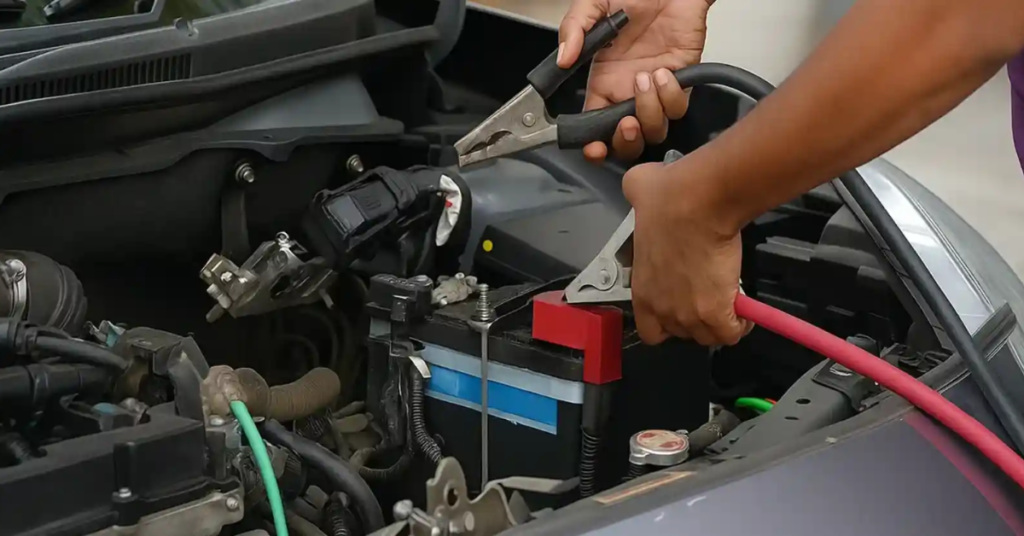
Try Jump-Starting Your Car
If your battery is weak, a jump-start may help you get going.
You need:
- Jumper cables
- Another car with a good battery
Steps (keep them simple and safe):
- Park the helper car near your car.
- Connect the red cable to both positive ends.
- Connect the black cable to the negative end of the helper car’s battery.
- Connect the other black end to a metal part of your car.
- Start the helper car.
- Try starting your car after one minute.
If the car starts, drive for at least 20 minutes to charge the battery.
Make Sure You Have Enough Fuel
It sounds too simple, but it happens. Sometimes the fuel gauge is not accurate. Sometimes the slope of the road makes the fuel level look higher than it is.
If you are unsure, add some fuel and try again. Low fuel pressure can stop the car from starting.
Check Your Key or Start Button
If your car has a push-start system, the issue may be the key fob. Try these steps:
- Replace the key battery if you have a spare.
- Hold the key close to the start button.
- Try pressing the brake harder while starting.
If you use a physical key, check if the key turns normally. A stuck ignition switch can also prevent the car from starting.
Look Under the Hood for Loose Wires
Sometimes a cable gets loose due to bumps, heat, or vibration. Look for:
- Loose battery wire
- Disconnected sensors
- Loose fuse box connections
Do not touch anything you are unsure about. Just look and observe. If something looks out of place, tightening it gently may help.
Check the Fuses
A faulty or burned-out fuse can keep your car from starting. The fuse box is usually near the dashboard or under the hood.
Look for a fuse labeled:
- IGN (ignition)
- START
- ECU
If a fuse is burned, replacing it is a quick fix. Always use the same amp rating.
If you have checked everything and still face trouble, Car Battery Replacement Sharjah can help you solve battery-related issues quickly without towing your car.
Check for a Bad Starter
If your battery is good but the car only clicks, the starter may be the problem. One simple test:
- Turn the key and listen.
- If there is a single loud click and nothing happens, the starter might be stuck.
In some cases, gently hitting the starter with a small tool (not too hard) can help it move. But this is only a temporary solution. You will need a proper fix later.
Does the Engine Crank but Not Start?
If your engine turns but does not start, the problem may be:
- No fuel
- Weak spark
- Faulty sensors
- Clogged fuel pump
These issues may need a mechanic. But knowing the symptoms helps you explain the problem clearly.
Try Resetting the Car’s Computer
Modern cars have computers that control everything. Sometimes, a simple reset helps.
To reset:
- Disconnect the negative battery terminal.
- Wait 1–2 minutes.
- Connect it back.
- Try starting the car.
This clears small errors that may stop the car from starting.
Check the Security System
Some cars do not start if the security system is active. Try unlocking the car with the key instead of the remote. Then lock and unlock again. Sometimes the immobilizer blocks the engine for safety reasons.
Smell or See Anything Unusual?
If you smell burning, fuel smell, or see smoke, do not try to start the car. Step back and call for help. Safety always comes first.
Know When It’s Time to Call a Tow Truck
You should call for towing if:
- The car makes loud grinding noises
- You smell burning
- The engine is flooded
- The car is stuck in gear
- You tried every step, and nothing works
Calling early prevents bigger damage.
How to Prevent This Problem in the Future
A few simple habits can keep your car ready every day:
- Check your battery twice a year: Heat and time weaken the battery.
- Keep your fuel tank at least 25% full: Low fuel harms the pump.
- Service your car on time: Regular care prevents sudden breakdowns.
- Listen to your car: Strange sounds are early warnings.
- Switch off lights properly: Leaving the lights on drains the battery.
Final Thoughts
A car that won’t start can feel stressful. But with the right steps, many issues can be fixed quickly.
Most problems come from the battery, fuel, or simple mistakes. Before you call a tow truck, take a moment to check your car. These small steps can save time, money, and frustration.
Stay calm, stay safe, and remember you are more capable than you think. With a little patience and basic checks, you can get back on the road with confidence.